The dealer stack is about to look different. Here's what's coming, what's hype, and what dealer principals should be planning for now.
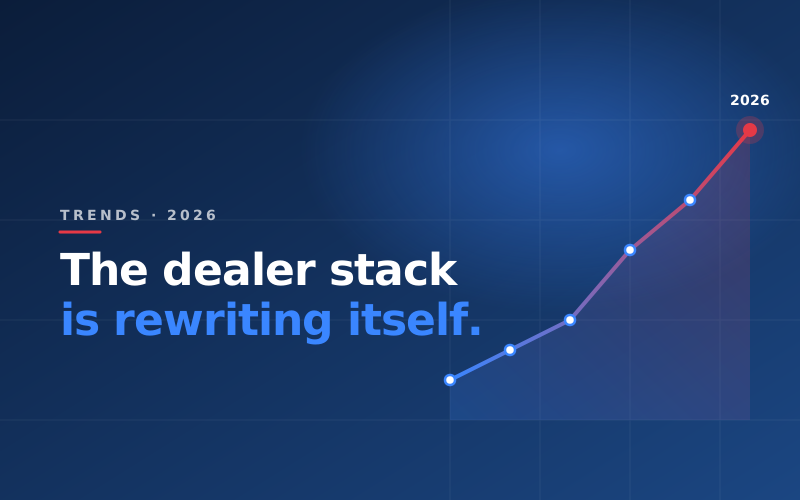
Predictions are a hazardous business. The auto retail technology stack has been getting "transformed" in trade-press headlines for a decade and a half, and a lot of dealer principals are still running the same DMS their grandfather chose. Skepticism is earned.
That said, four shifts are real, accelerating, and worth planning around. None of them require buying anything in the next 90 days. All of them shape the choices a dealer principal will make over the next 24 months.
The 2024-2025 wave of dealership AI was largely chatbots and lead-routing tools. Useful, but at the periphery of the business. The 2026 wave is agentic: software that takes multi-step actions on the dealer's behalf, inside the systems the dealer already uses, with auditable decision trails.
The dealers who pilot agentic workflows this year (credit pull plus rate comparison plus menu personalization in one orchestration) get a measurable PVR lift and a labor savings the same quarter. The dealers who wait for "stable" enterprise rollouts in 2027 will buy from whoever the early adopters validated.
FTC Section 5 UDAP enforcement, GLBA, Red Flags, and the patchwork of state-level escalation are pushing dealer compliance toward something like compliance-as-code. Disclosures get logged the moment they're presented. Audit packets assemble themselves. Exception handling is rule-based, not memory-based.
The dealers building this now save themselves a 9-figure headline later. The largest recent FTC settlement was $20M. The settlements ahead will be larger, because the regulators are getting better at the file format. Dealers who can produce a complete deal jacket in 30 seconds will sleep at night. Dealers who can't, won't.
A typical dealership in 2026 still runs 5 to 8 disconnected systems for F&I alone. CRM, DMS, credit, desking, menu, eContract, compliance, customer-facing presentation. None of them share a data layer. Every deal hops between systems with the manager re-keying as it goes.
The economics of that stack are getting worse. Software bills compound. Errors compound. Compliance gaps compound. The next twenty-four months will see a wave of consolidation as dealer principals look at the line items and realize that one platform can replace five-to-eight at lower total cost. Not all consolidation will be intelligent. Some will be ugly forced migrations. But the direction is clear.
For the last decade, "digital retail" mostly meant prettier websites and a credit application form. The 2026 version is real: a dealership-branded customer-facing avatar that walks the buyer through F&I before they sit in the chair. Payment preferences captured. Protection options explained. Disclosures presented inline, not buried in a packet.
Why now? Because customer trust in the F&I office is at a generational low. Only 5% of customers say F&I has their best interests at heart. Dealers who flip that experience, who make the F&I conversation transparent, customer-paced, and visibly fair, pull ahead on CSI, on penetration, and on the chargeback line. Dealers who don't, lose buyers to the ones who do.
Three practical moves for the next twelve months:
None of this is "rip and replace tomorrow." All of it is "know where the puck is going." The dealer principals who do that work this year will be making good decisions in 2027. The ones who don't will be reacting to whatever their competitors did first.
This article draws on themes from the AiF&I white paper. Download the 12-page PDF for the deeper take, with sources, charts, and the full role-by-role breakdown.